
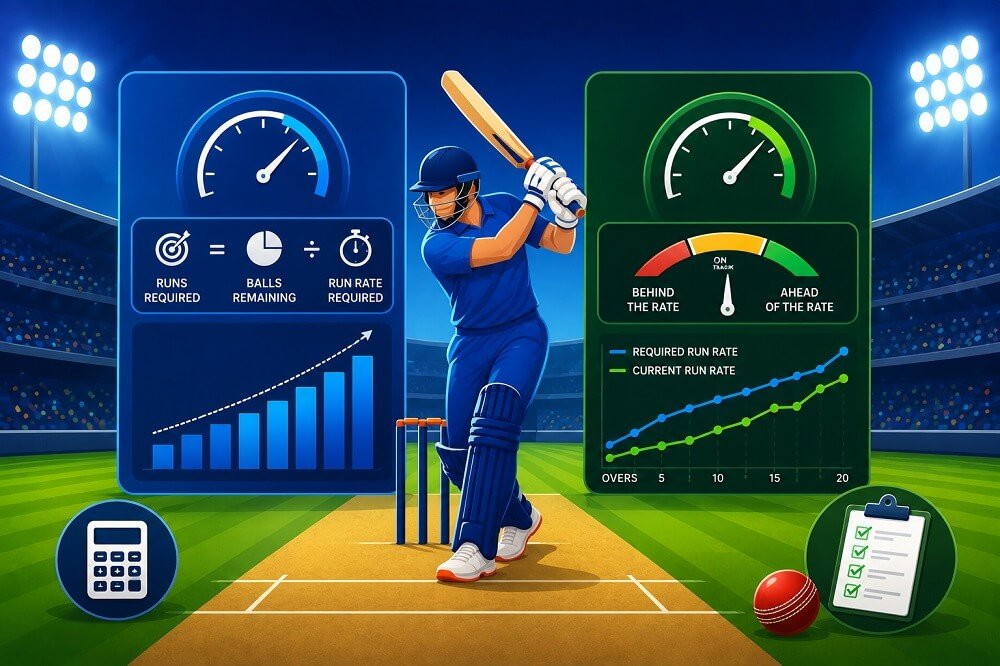
Run rate is one of the most important statistics in limited-overs cricket. Whether you’re watching a T20 or an ODI, commentators frequently discuss the current run rate (CRR) and required run rate (RRR) to explain how a chase is progressing.
Understanding these two metrics helps fans follow match momentum, evaluate team strategy, and better understand pressure situations with insights from play99exch.
What Is Run Rate?
Run rate is the average number of runs scored per over.
It helps measure how quickly a team is scoring throughout an innings.
The higher the run rate, the faster a team is accumulating runs.
What Is Current Run Rate?
Current Run Rate (CRR) is the average number of runs scored so far.
Formula
Current Run Rate = Total Runs ÷ Overs Faced
Example
- Score: 96/2
- Overs: 12
- Current Run Rate = 96 ÷ 12 = 8.00
This means the batting team has scored an average of 8 runs per over.
What Is Required Run Rate?
Required Run Rate (RRR) is used only during a run chase.
It shows how many runs per over the batting team must score from the remaining overs to reach the target.
Formula
Required Run Rate = Runs Needed ÷ Overs Remaining
Example
- Target: 181
- Current Score: 120/3
- Runs Needed: 61
- Overs Remaining: 6
- Required Run Rate = 61 ÷ 6 = 10.17
The chasing team now needs just over 10 runs per over.
Why Run Rate Matters
Run rate provides insight into:
- Match momentum
- Pressure during a chase
- Batting intent
- Bowling effectiveness
- Team strategy
It helps explain whether a batting side is ahead of or behind the required scoring pace.
Current Run Rate vs Required Run Rate
| Current Run Rate | Required Run Rate |
| Average scoring rate so far | Average scoring rate needed from now on |
| Calculated throughout the innings | Used only when chasing a target |
| Reflects past scoring | Focuses on the remaining chase |
| Changes after every over | Changes after every ball, over, run, or wicket |
Both numbers should be viewed together to understand the match situation.
Factors That Influence Run Rate
Several factors affect both CRR and RRR:
Wickets Remaining
Teams with more wickets in hand can often increase their scoring rate later in the innings.
Overs Remaining
Fewer overs usually increase the pressure if many runs are still needed.
Pitch Conditions
A batting-friendly pitch may support higher scoring, while a difficult surface can slow the run rate.
Bowling Quality
Accurate bowling, especially in the death overs, can reduce scoring opportunities.
Weather
Rain interruptions or dew can influence the pace of a chase.
Match Strategy During a Chase
Captains and batters continuously compare the current run rate with the required run rate.
Common strategies include:
Keep the Required Rate Under Control
Avoid allowing the required run rate to climb sharply during the middle overs.
Build Partnerships
Strong partnerships help maintain scoring while protecting wickets.
Target Specific Overs
Teams often attack overs bowled by less experienced bowlers while respecting specialist bowlers.
Finish Strong
Batters may save wickets to accelerate during the final overs if conditions allow.
Common Mistakes
Avoid these misconceptions:
- Assuming a higher current run rate guarantees victory.
- Ignoring wickets remaining.
- Focusing only on one over instead of the overall chase.
- Forgetting that pitch and weather conditions affect scoring.
- Assuming the required run rate cannot be reduced quickly.
- Cricket matches can change rapidly with a few boundaries or wickets.
Responsible Betting Reminder
If you use run-rate statistics as part of your research:
- Combine them with team form, player performance, pitch reports, weather, and venue history.
- Treat run rates as analytical tools, not guarantees.
- Bet only where it is legal and if you meet the required age requirements.
- Set a fixed entertainment budget and avoid chasing losses.
Key Takeaways
- Current Run Rate measures scoring so far.
- Required Run Rate measures the scoring pace needed during a chase.
- Both metrics update throughout the innings.
- Wickets, overs remaining, pitch conditions, and bowling quality all influence run rates.
- Run rates help explain match momentum but cannot predict the final result.
Frequently Asked Questions
What is the current run rate?
Current run rate is the average number of runs scored per over during an innings.
What is the required run rate?
Required run rate is the average number of runs per over a chasing team must score to reach its target.
How is current run rate calculated?
Current Run Rate = Total Runs ÷ Overs Faced.
How is required run rate calculated?
Required Run Rate = Runs Needed ÷ Overs Remaining.
Which is more important: current run rate or required run rate?
Both are important. Current run rate shows how a team has scored so far, while required run rate indicates the pace needed to complete a successful chase.