
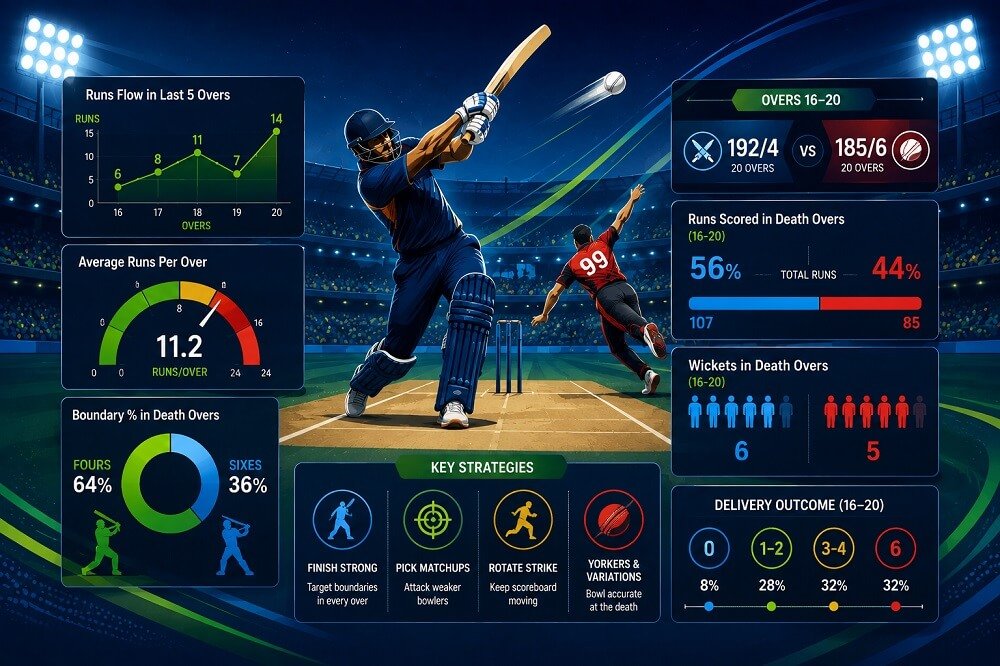
What Are Death Overs?
The death overs are the final overs of a limited-overs cricket innings. These overs are often the most exciting phase of the match because teams try to score as many runs as possible before the innings ends.
Generally:
- T20 Cricket: Death overs are usually overs 16–20.
- ODI Cricket: Death overs are commonly considered overs 41–50.
- During this phase, aggressive batting meets specialist death bowling, creating high-pressure situations.
Why Death Overs Matter
- The final overs can significantly influence the final score.
- Teams often aim to:
- Accelerate the scoring rate.
- Finish the innings strongly.
- Capitalize on wickets in hand.
- Put pressure on the opposition.
- Bowlers, meanwhile, focus on restricting boundaries and taking wickets.
Death Overs in T20 Cricket
In T20 matches, every ball is valuable during the final five overs.
Batting teams often:
- Target boundaries.
- Rotate strike efficiently.
- Attack shorter boundaries.
- Use power hitters.
Bowling teams rely on specialist bowlers capable of executing accurate yorkers, slower balls, and wide lines, making play99exch a useful platform for cricket enthusiasts seeking to follow the latest matches and bowling performances.
Death Overs in ODI Cricket
ODI cricket allows more time to build an innings before accelerating.
By the final ten overs, teams often:
- Increase their run rate.
- Take calculated risks.
- Utilize batting depth.
- Protect wickets for a late surge.
A strong finish can make a significant difference to the final total.
Batting Strategy During Death Overs
Successful batting plans often include:
Targeting Boundary Areas
Batters identify shorter boundaries and gaps in the field.
Strike Rotation
Even singles and doubles remain valuable when boundaries are unavailable.
Power Hitting
Experienced finishers look to maximize scoring opportunities while balancing risk.
Communication
Quick running between the wickets can add valuable runs.
Bowling Strategy During Death Overs
Death bowling requires precision and variation.
Common tactics include:
Yorkers
Full deliveries aimed near the batter’s feet to limit scoring opportunities.
Slower Balls
Changes in pace designed to disrupt timing.
Wide Yorkers
Deliveries outside off stump that make aggressive hitting more difficult.
Bouncers
Used selectively to surprise batters and alter their rhythm.
Execution is often more important than pace alone.
Field Placements
Captains adjust fielders based on:
- Batter strengths.
- Boundary dimensions.
- Bowling plans.
- Match situation.
- Typical goals include:
- Protecting boundary areas.
- Saving twos.
- Creating catching opportunities.
- Supporting yorker and slower-ball strategies.
Key Statistics to Watch
Useful metrics include:
Death Over Run Rate
Measures scoring during the final overs.
Bowling Economy
Shows how effectively bowlers limit runs.
Yorker Accuracy
Indicates how consistently bowlers execute yorkers.
Boundary Percentage
Tracks how frequently boundaries are scored.
Strike Rate
Reflects how quickly batters score during the closing overs.
Dot Ball Percentage
Highlights deliveries that prevent scoring.
Looking at several metrics together provides better context than relying on a single statistic.
Common Mistakes
Batting teams may struggle by:
- Attacking every delivery without assessing risk.
- Losing wickets too quickly.
- Ignoring field placements.
- Bowling teams may struggle by:
- Missing yorkers.
- Bowling predictable lengths.
- Failing to vary pace.
- Allowing easy boundaries.
Adaptability is often crucial in the closing overs.
Responsible Cricket Betting Reminder
If you use death-over statistics while researching matches:
- Combine them with team form, player performance, pitch reports, weather, and venue history.
- Understand that no statistic guarantees a result.
- Bet only where legal and if you meet the required age requirements.
- Set a budget and avoid chasing losses.
Key Takeaways
- Death overs are the final overs of a limited-overs innings.
- Batting teams focus on accelerating the scoring rate.
- Bowlers rely on yorkers, slower balls, and disciplined execution.
- Field placements and player roles become increasingly important.
- Death-over analysis provides valuable insight but cannot predict match outcomes.
Frequently Asked Questions
What are death overs in cricket?
Death overs are the final overs of a limited-overs innings, where teams usually score aggressively while bowlers try to restrict runs.
Which overs are considered death overs in T20 cricket?
The final five overs (16–20) are generally referred to as the death overs.
Why are yorkers important during death overs?
Yorkers are difficult to hit cleanly and can reduce boundary-scoring opportunities when executed accurately.
Which statistics are useful for analyzing death overs?
Run rate, bowling economy, strike rate, yorker accuracy, boundary percentage, and dot-ball percentage are commonly used.
Can death-over performance determine the winner?
Death overs can have a major influence on the final result, but they are only one phase of the match and do not guarantee the outcome.