
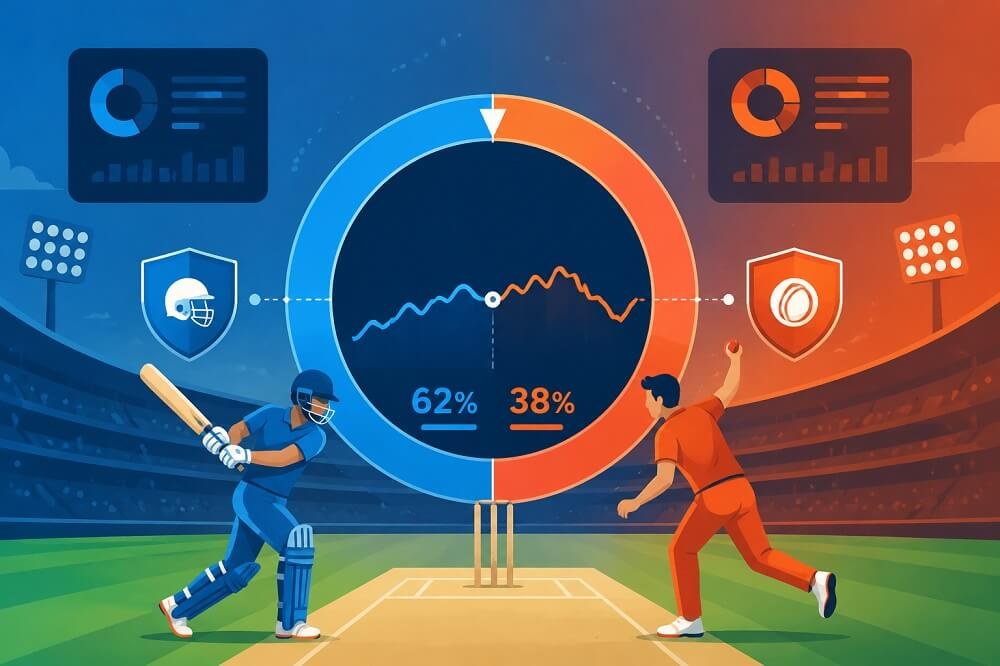
Cricket win probability has become one of the most popular statistics for fans following a match. Whether a team is given a 75% chance of winning before the first ball or its probability changes from 35% to 80% during a run chase, the number is designed to show how likely each team is to win based on the information available at that moment.
But how is cricket win probability actually calculated?
In this guide, we explain how cricket win probability works, which factors influence it, how live win probability changes during a match, and why a team with a high percentage can still lose. We’ll also look at how platforms such as play99exch can be used by cricket fans to follow match predictions, win probabilities, and changing game situations.
What Is Cricket Win Probability?
Cricket win probability is an estimated percentage representing a team’s chance of winning a match.
For example:
- Team A: 68%
- Team B: 32%
This does not mean Team A is guaranteed to win. It means that, according to the prediction model and the information available, Team A is considered more likely to win.
A 70% win probability still means the team could lose roughly 3 times out of 10 in comparable situations.
Win probability is therefore a forecast, not a prediction of certainty.
How Is Cricket Win Probability Calculated?
There is no single universal formula used by every cricket website or analytics provider.
Most systems combine historical match data, team strength, player performance and current match conditions. During a live match, the model can continuously update the calculation using information such as the score, wickets, overs remaining and required run rate.
A simplified representation is:
Win Probability = f(team strength, score, wickets, overs, venue, conditions, players and historical data)
More sophisticated systems may use statistical models, machine learning, simulations or combinations of several techniques.
Research into cricket prediction models has also examined factors such as venue, toss outcome, batting order, pitch conditions and team rankings when estimating outcomes.
The Main Factors Behind Cricket Win Probability
1. Current Score
The score is one of the most important variables in limited-overs cricket.
Suppose Team A scores 190/6 in a T20 match. Team B then begins its chase.
If Team B reaches:
80/1 after 8 overs
the model may give Team B a strong chance because the required scoring rate is still manageable and only one wicket has fallen.
But if Team B is:
60/5 after 10 overs
its win probability could fall dramatically even though the target has not changed.
2. Wickets Remaining
Wickets represent the remaining batting resources of a team.
A team chasing 100 runs with nine wickets remaining is in a very different position from a team needing the same 100 runs with only three wickets left.
For this reason, live win-probability models generally consider both:
- Runs required
- Wickets remaining
This is particularly important in T20 and ODI cricket.
3. Overs or Balls Remaining
Time is another major factor.
A team requiring 60 runs from 60 balls is generally in a much better position than a team requiring 60 runs from 30 balls.
As the number of remaining deliveries decreases, the required run rate becomes increasingly important.
For example:
60 runs from 60 balls = 6.00 runs per over
while:
60 runs from 30 balls = 12.00 runs per over
The second situation requires much more aggressive scoring and therefore carries greater uncertainty.
4. Required Run Rate
During a chase, the required run rate is one of the clearest indicators of the difficulty of the task.
The basic calculation is:
Required Run Rate = Runs Required ÷ Overs Remaining
For example, if a team needs 90 runs from 10 overs:
90 ÷ 10 = 9 runs per over
A model can compare this requirement with the team’s expected scoring rate under the current match conditions.
5. Current Run Rate and Scoring Pattern
The model also looks at how quickly the batting team has been scoring.
A team scoring at 10 runs per over may have a much stronger probability of chasing a target requiring 9 runs per over than a team scoring at 6 runs per over.
However, scoring rate alone is not enough.
The model also needs to consider:
- Wickets lost
- Batters at the crease
- Quality of the bowling attack
- Balls remaining
- Match conditions
6. Team Strength
Pre-match win probability usually starts with an assessment of the two teams.
Historical performance can help estimate relative team strength, including:
- Recent results
- Batting strength
- Bowling strength
- Player quality
- Team rankings
- Head-to-head performance
- Performance in the relevant format
A strong T20 team, for example, may receive a higher starting probability than a weaker opponent before the match begins.
However, once the match starts, current match circumstances can quickly become more important than pre-match ratings.
7. Individual Player Performance
Players can significantly affect win probability.
A model may consider factors such as:
- Recent batting form
- Bowling performance
- Strike rate
- Batting average
- Economy rate
- Wicket-taking ability
- Historical performance
- Matchups between batters and bowlers
The availability of important players can also influence pre-match predictions.
For example, losing a team’s leading fast bowler before an important match could change its expected bowling strength.
8. Venue and Pitch Conditions
The venue can influence the expected result.
Some grounds historically produce high-scoring matches, while others may favor bowlers.
Prediction models can consider factors such as:
- Average first-innings score
- Average chasing score
- Boundary dimensions
- Spin-friendly conditions
- Pace-friendly conditions
- Dew
- Home advantage
Research on cricket prediction has specifically identified venue and pitch conditions among variables that can contribute to predictive models.
9. Toss Result
The toss can sometimes influence the starting probability because the decision to bat or bowl may interact with venue and weather conditions.
However, the toss should not automatically be treated as a guarantee of victory.
Its importance depends on the format, venue, conditions and historical evidence.
For example, in some conditions, chasing may become easier later in the game, while in other situations batting first can be advantageous.
10. Weather and Match Conditions
Weather can also affect the probability calculation.
Rain is particularly important in limited-overs cricket because it can reduce the number of overs available.
When an innings is interrupted, cricket uses the Duckworth/Lewis/Stern (DLS) method to calculate revised targets in applicable limited-overs matches. ICC playing conditions specify that revised targets are calculated using the current DLS method when qualifying interruptions reduce the available overs.
A win-probability model may therefore need to account for the possibility of:
- Rain
- Reduced overs
- Revised targets
- Delays
- Changing playing conditions
How Live Cricket Win Probability Changes
One of the most interesting aspects of win probability is that it can change after almost every significant event.
Imagine a T20 chase:
Target: 180
After 5 overs:
45/0
The chasing team may have a strong probability because it has scored quickly without losing a wicket.
Then a wicket falls.
The probability may drop.
A few overs later, two more wickets fall.
The probability could fall sharply again.
Then a batter hits three consecutive sixes.
The probability can rise again.
This creates a constantly changing picture of the match.
Example of Live Win Probability
Consider this hypothetical T20 chase:
| Match Situation | Team A Win | Team B Win |
|---|---|---|
| Before match | 52% | 48% |
| Team A scores 185 | 64% | 36% |
| Team B 55/0 after 5 overs | 48% | 52% |
| Team B 100/1 after 10 overs | 30% | 70% |
| Team B 125/4 after 15 overs | 47% | 53% |
| Team B needs 25 from 12 balls | 58% | 42% |
| Team B needs 8 from 6 balls | 35% | 65% |
These numbers are illustrative rather than predictions for a particular match.
The important point is that probability changes as the evidence changes.
Why Does Win Probability Change So Quickly?
A single wicket can have a large statistical impact.
For example, suppose a team needs 50 runs from 30 balls and has eight wickets remaining.
If two wickets fall quickly, the model may reduce the team’s probability because:
- Fewer established batters remain.
- New batters may take time to settle.
- The bowling team has gained momentum.
- The required scoring rate remains high.
- The risk of losing all wickets has increased.
This is why a match can appear to swing dramatically after only a few deliveries.
Pre-Match vs Live Win Probability
There are two major types of cricket win probability.
Pre-Match Win Probability
Calculated before the match begins.
It can use:
- Team strength
- Player availability
- Recent form
- Venue
- Historical data
- Pitch expectations
- Toss information, once available
For example:
India 62% — Australia 38%
This means the model considers India the more likely winner before play, based on its inputs.
Live Win Probability
Calculated while the match is happening.
It can incorporate:
- Current score
- Wickets
- Overs remaining
- Required run rate
- Current batting partnership
- Bowling resources
- Match situation
- Updated conditions
Live probability is therefore much more dynamic.
Is Cricket Win Probability the Same as Betting Odds?
No.
Win probability and betting odds are related but are not exactly the same thing.
A prediction model produces an estimated probability.
A betting market produces odds based on market prices, bookmaker margins, available information and betting activity.
For example, a model could estimate:
Team A = 60%
while a market price may imply a different probability after accounting for the bookmaker’s margin.
Therefore, comparing model probability with market odds requires additional calculations and careful interpretation.
Why Can a Team With 90% Win Probability Still Lose?
This is one of the most important things to understand.
A 90% probability does not mean a guaranteed win.
It means that the model estimates the team will win approximately 90% of comparable situations and lose approximately 10%.
In cricket, a small number of unlikely events can completely change a match:
- A batter gets out unexpectedly.
- A bowler takes two wickets in an over.
- A lower-order batter produces a quick cameo.
- A team concedes several boundaries.
- A rain interruption changes the target.
- A dropped catch changes the expected outcome.
Cricket contains substantial uncertainty, so even a heavily favored team can lose.
How Accurate Is Cricket Win Probability?
Accuracy depends on the model, data quality, sport format and situation.
A good model should not simply pick the eventual winner. It should also produce probabilities that are well calibrated.
For example, if a model gives teams a 70% win probability across a large group of matches, approximately 70% of those teams should win over the long run if the model is properly calibrated.
This is why evaluating probability models involves more than asking:
“Did the prediction come true?”
A prediction of 90% that loses is not necessarily a bad prediction.
Similarly, a prediction of 50% that happens to pick the winner is not necessarily a highly accurate model.
Common Mistakes When Reading Cricket Win Probability
Mistake 1: Treating 70% as a guarantee
70% means more likely, not certain.
Mistake 2: Looking only at the percentage
Always consider the match situation behind the number.
Mistake 3: Assuming one model is always correct
Different providers may use different data and methodologies.
Mistake 4: Ignoring wickets
Runs and required rate alone do not tell the entire story.
Mistake 5: Ignoring match format
A probability model for Test cricket can be fundamentally different from one designed for T20 cricket.
How to Read Today’s Cricket Win Probability
When looking at the win probability for today’s match, ask five simple questions:
- What is the current score?
- How many wickets are remaining?
- How many overs or balls remain?
- What is the required run rate?
- Which team has the stronger remaining resources?
The percentage becomes much easier to understand when these factors are considered together.
Cricket Win Probability in T20, ODI and Test Cricket
Win probability works differently across formats.
T20 Cricket
T20 matches are highly influenced by:
- Current run rate
- Required run rate
- Wickets
- Balls remaining
- Powerplay performance
- Death-over scoring
- Bowling resources
Because only 120 balls are available per innings, individual events can have a large effect.
ODI Cricket
ODIs provide more time for teams to recover from setbacks.
Important variables include:
- Run rate
- Wickets
- Overs remaining
- Batting depth
- Bowling resources
- Target size
Test Cricket
Test-match probability is considerably more complex.
Models may need to account for:
- Runs
- Wickets
- Sessions remaining
- Innings state
- Lead or deficit
- Pitch deterioration
- Weather
- Draw probability
Unlike limited-overs cricket, Test matches can have three major possible outcomes:
Win, loss or draw.
The Future of Cricket Win Probability
Cricket prediction is increasingly data-driven.
Modern analytics can combine large historical datasets with real-time match information. Machine-learning research is also being applied to cricket outcome prediction, including models that consider venue, toss, batting order, pitch conditions and team rankings.
As ball-by-ball datasets become richer, future systems may become better at estimating the impact of specific situations, player matchups and changing conditions.
However, no model can remove uncertainty from cricket completely.
That uncertainty is part of what makes the sport unpredictable—and exciting.
Final Thoughts
Cricket win probability is a statistical estimate, not a guarantee.
The number combines different pieces of information to answer one simple question:
“Given everything we know right now, which team is more likely to win?”
Before the match, the model may focus heavily on team strength, players, venue and historical performance. During the match, the current score, wickets, overs remaining and required run rate become increasingly important.
That is why today’s win probability can move from one team to another throughout a match.
The best way to use win probability is not simply to ask whether the percentage is high or low. Instead, understand why the percentage changed.
That is where cricket analytics becomes most useful—and most interesting.
Frequently Asked Questions
What does cricket win probability mean?
Cricket win probability is the estimated percentage chance that a team will win a match based on available information.
How is live win probability calculated?
Live models can use the current score, wickets, overs or balls remaining, required run rate, team strength, players, venue and other match conditions.
Can win probability be 100%?
It can approach 100% in practical situations, but before the result is officially complete, probability is generally better understood as an estimate rather than a guarantee.
Why does win probability change after a wicket?
A wicket removes a batting resource and can change the expected scoring ability of the team, so the model may significantly reduce its estimated chance of winning.
Is win probability the same as match prediction?
Not exactly. A match prediction may simply identify the expected winner, while win probability expresses the estimated likelihood numerically.
Does the toss affect win probability?
It can. The effect depends on venue, format, pitch, weather and whether batting first or chasing has historically provided an advantage.
Does win probability guarantee the result?
No. Probability describes uncertainty. Even a team with a very high probability of winning can lose.